










Date: August
27, 2011
Location: Shot Rock
NELM: 7.0 to 7.2
Transparency: 4/5
Seeing: 3/5
Telescope:
22” f/4.0 on
equatorial platform and AstroTelescopes 4” f/11 doublet
refractor on German equatorial mount.
Eyepieces: 24mm
Panoptic (96x), 12.5mm BGO (184x), 10mm ZAO-II (230x),
9mm BGO (255x), 7mm BGO (328x), 6mm ZAO-II (383x), 5mm
BGO (460x) and 4mm ZAO-II (575x)
First time at Shot Rock since November last year. There was at least 10 feet of snow when I attempted to observe there on July 2, 2011. Ended up going to IHOP.
Note: All object parameters in parenthesis are listed in RA, Dec, size and listed magnitude without commas.M-101
Supernova
Very
easily seen even in the 4” refractor at 110x. About 2x
brighter than the two neighboring stars forming a very
flat isosceles triangle that is perpendicular to the
core.
 Ethos
1 (19 16
31.5 +36
09 48
1 x 0.3’ `17.6*)
Ethos
1 (19 16
31.5 +36
09 48
1 x 0.3’ `17.6*)
22”
f/4 (230 and 383x) – Very faint, 3:1 elongated glow. Ultrablock
makes it disappear and the CLS filter helps quite a bit. The CLS
slightly enhances the two lobes, so I’m’ pretty sure
that I observed the nebulous lobes, not the double stars
as suspected after the last session. PA = 150
and about 1’ long.
Note: A
couple days after leaving Jimi’s place in West Texas, he
reported superb seeing and transparency and was able to
“bust” apart the two lobes and the round part in the
middle. He
also saw both double stars in each lobe! That takes
some impressive seeing and aperture. The separation
of the double stars is about 5” and the magnitudes range
from 17 to 18th magnitude.
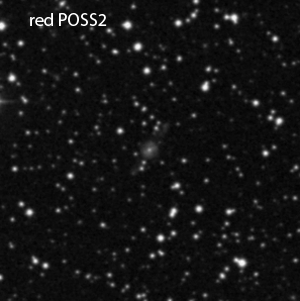
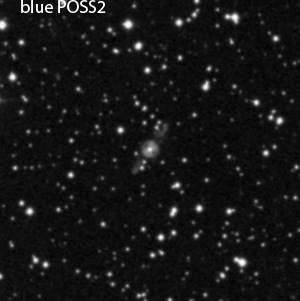
 Kohoutek
3-46 (19
50 00.3 +33
45 53 0.5’
16.4p )
Kohoutek
3-46 (19
50 00.3 +33
45 53 0.5’
16.4p )
22”
f/4 (230, 328 and 383x) – Field was easily located, but
no nebula. Tried
the CLS, Ultrablock and O-III.
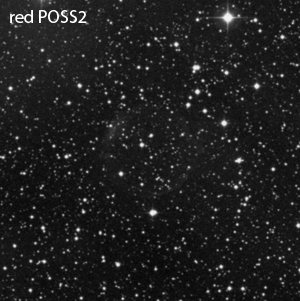
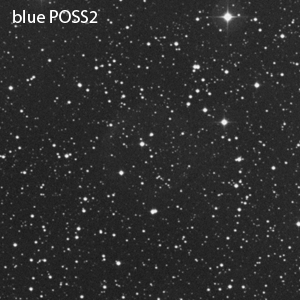
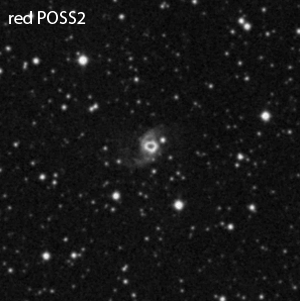
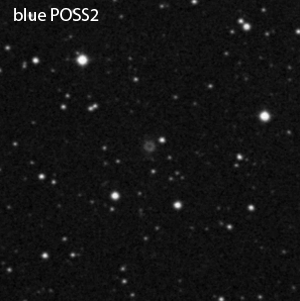
It appears “bright” in the red POSS2 plates, while
barely visible in the blue POSS2 plates. Always pays to
check the blue POSS2 plates as human vision is most
sensitive to the green wavelengths, which is more
closely depicted by the blue POSS2 plates.
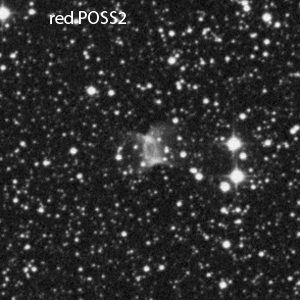
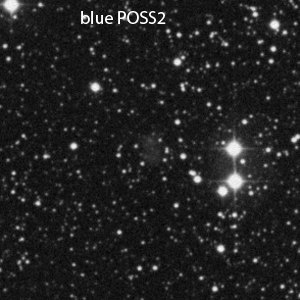
 Wein
1-10 (20
31 52.4 +48
52 51 3.2’ 15.1v 18.1*)
Wein
1-10 (20
31 52.4 +48
52 51 3.2’ 15.1v 18.1*)
22”
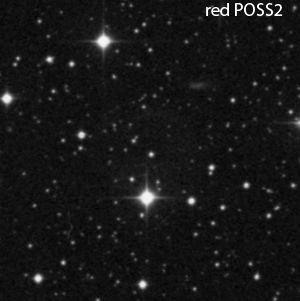
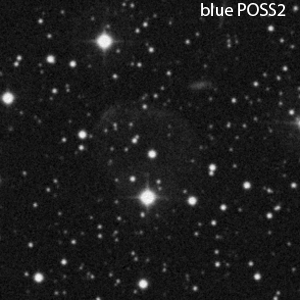
f/4 (128, 184 and 255x) – Field was located, but no
nebula. Tried
the CLS, Ultrablock and O-III.
Note: The
Wein catalogue is my ultimate challenge for planetaries
as a good percentage “appears” to be “easy”, but tough
in the eyepiece. I
feel good when successful in observing these guys. So when you
think you’re done with the Abell PNe’s, take on the Wein
Challenge!
 PNG
027.6 + 16.9 (17
41 41 +03
07 02 94” 16.3p)
PNG
027.6 + 16.9 (17
41 41 +03
07 02 94” 16.3p)
22”
f/4 (128, 184 and 255x) – Extremely faint round diffuse
glow in a very star rich field. 1.1’ across.
The 14.9 mag central star was slam dunk. A blazing 9.7
mag star lies on the south edge and a mag 10.2 star lies
1.2’ from the NEN edge.
A third star, mag 9.7, lies 1.9 off the west
edge. These
three stars make it very difficult to observe, but under
the transparent Shot Rock skies made it
observable...barely.
 Kohoutek
4-55 (20
45 10 +44
39 10 27” - -)
Kohoutek
4-55 (20
45 10 +44
39 10 27” - -)
22”
f/4 (184, 255, 328x) – Extremely faint very small round
glow next to a faint 16th magnitude star to
the WNW. This is a very
difficult object!
 Shakhbazian
302 (23
17 22 -11
42 31 mag
17.28+ size
2.2’ 9
members)
Shakhbazian
302 (23
17 22 -11
42 31 mag
17.28+ size
2.2’ 9
members)
22”
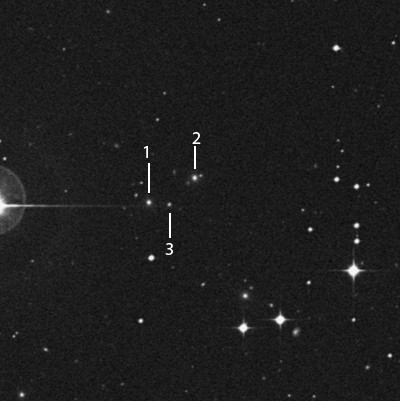
f/4 (383,
460 and 575x) – Observed three members. 1 – brightest
of the bunch, considerably faint, very small round glow. 2 – Very
faint, very small round glow and the last one, 3, is
extremely faint, very small round glow. The three
visible members form a very shallow equilateral
triangle. A
blazing mag 6.3 star lies just 4.0’ west inhibits the
view, if not kept off the field. A string
of 11 to 12th magnitude stars lies about
4.3’SW.
 Shakhbazian 304 (23 43 40 -12 28 21 mag 16.97+ size
2.6’ 8
members)
Shakhbazian 304 (23 43 40 -12 28 21 mag 16.97+ size
2.6’ 8
members)
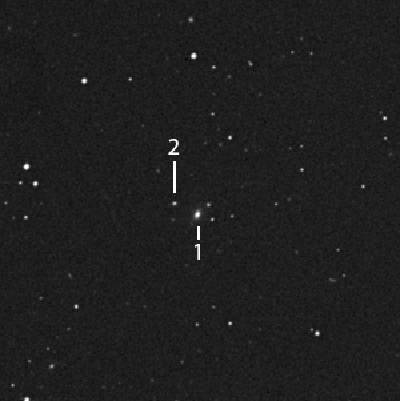
22”
f/4 (383 and 460x) – Only two members seen. The first one
is held steadily as a considerably faint small round
glow. The
other one pops in and out.
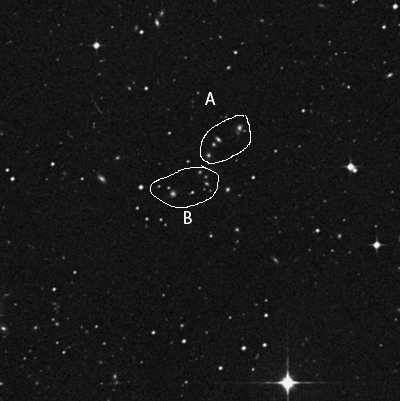 Shakhbazian
296 (21
40 46 -14
17 41 mag
17.81+ size
3.4’ 16
members)
Shakhbazian
296 (21
40 46 -14
17 41 mag
17.81+ size
3.4’ 16
members)
22”
f/4 (328,
383 and 460x) – Lumpy darkness, not well resolved. Group A was
seen as one glow and group B was pretty lumpy.
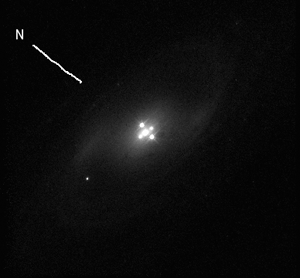
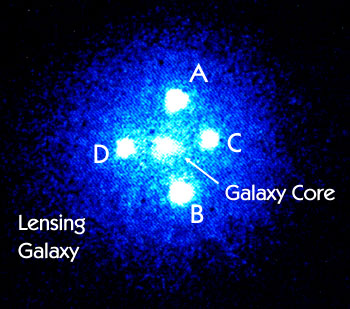 Einstein’s Cross (22 40
30.2 +03
21 30)
Einstein’s Cross (22 40
30.2 +03
21 30)
22”
f/4 (460, 3.7mm Ethos) – Suspected stellaring on one
end. But
not sure.
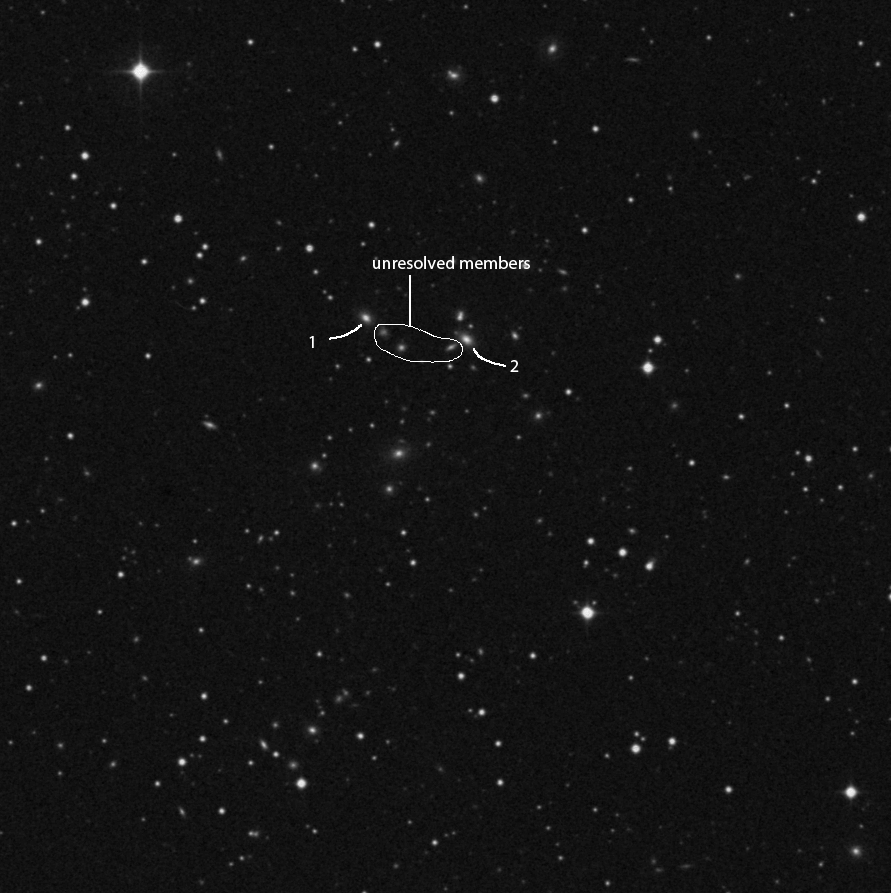 AGC 278 (01 57 18.0 +43 13 00)
22”
f/4 (255,
328 and 383x) – Two individual members and three members
were unresolved.
Both resolved members are very faint, very small
round glows.
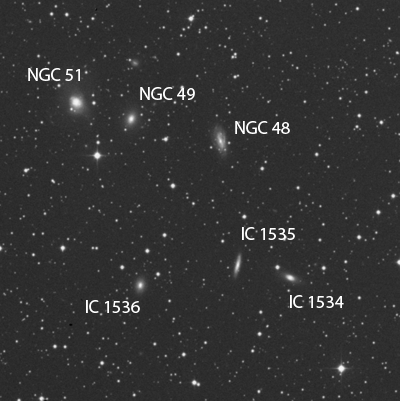 NGC 51
and IC 1535 trios
00 14 34,9 (NGC 51 coordinates)
NGC 51
and IC 1535 trios
00 14 34,9 (NGC 51 coordinates)
22”
f/4 (184, 255, 328x) –
This par if linear trios forms a nice group in a star
rich field that fits in a 12’ field so it will fit in a
high power wide field eyepiece or a medium power narrow
field eyepiece.
NGC 51 (00 14
34.9 +48 15 22 1.2x0.9’ 14.1p)
– Bright very slightly elongated glow with well-defined
edges. PA =
45 and 0.6’ long. A
couple very faint stars are just off the SW edge and two
faint stars are 0.3’ off the NE edge.
NGC 49 (00 14
22.4 +48 14 48 1.1x1.0’ 14.7p)
– Considerably bright 3:2 elongated glow with somewhat
defined edges. A
faint 16th mag star lies just off the SSE end
and another on lies off the NE edge. This is
the dimmest of the trio.
NGC 48 (00 14
02.1 +48 14 04 1.4x0.9’ 14.4p)
– Considerably bright 3:1 elongated glow with diffuse
edges. Much
brighter very small core.
Two extremely faint knots or stars are detected
on the southern tip, one on each side. PA = 30 and
0.9’ long. A
pair of 16th magnitude stars flank the SE and
SW edges.
IC 1535 (00 13
57.4 +48 09 27 1.3x0.3’ 15.1)
– Faint 3:1 elongated glow with defined edges. Brighter round
center. PA
= 170 and 0.7’ long.
IC 1534 (00 13
45.6 48 09 06 1.0x0.4’ 14.8p)
– Considerably bright 2:1 elongated fairly high surface
brightness glow. Upon
observing this galaxy a little closer showed very faint
extensions that is easily missed. PA = 60 and
0.7’ long (total) and 0.4’ long (bright part). A 12.5 mag
star lies 0.6’ away to the NE.
IC 1536 (00 14
19.2 +48 08 35 0.9x0.8’ 15.4)
– Considerably faint slightly elongated glow with
diffuse edges. PA
= 0 and 0.4’ long.
An upside down “y” of 13th magnitude
stars is just north.
Back to Observing Reports
All Observing Reports are copyrighted by Alvin Huey. You can print them for personal use only.
Components Aids Guides Observing Guides Reports